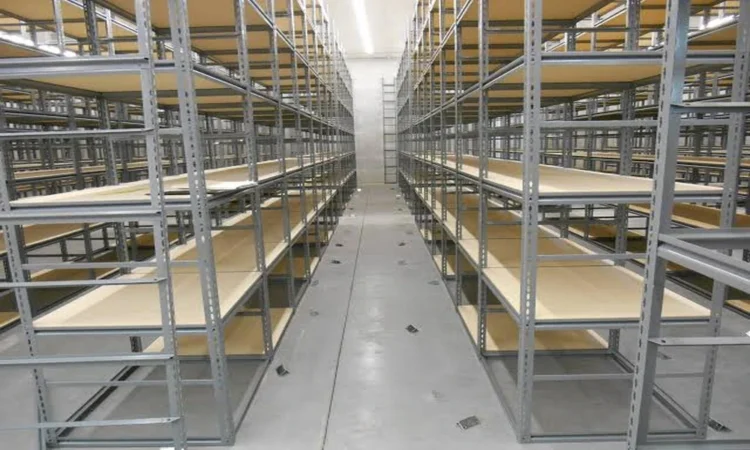
Light-duty shelving matters in back-of-house facility storage because it organizes the supplies, spare parts, and materials that keep a building running, and it does so at a lower cost and with more flexibility than heavy industrial racking. Custodial closets, maintenance rooms, mailrooms, and stockrooms all depend on shelving that is easy to install, adjust, and expand.
Slips, trips, and falls are among the leading causes of workplace injuries (Occupational Safety and Health Administration).
What is light-duty shelving?
Light-duty shelving is adjustable steel shelving designed for moderate loads such as boxed supplies, tools, files, and small parts. It typically uses posts and shelves that can be repositioned as storage needs change.
How light-duty differs from racking
Light-duty systems differ from pallet racking and heavy industrial shelving. They are intended for hand-loaded storage in interior rooms rather than forklift-loaded storage in warehouses. That distinction makes them a good fit for back-of-house spaces in schools, offices, hospitals, and retail stores.
How light-duty systems fit a storage line
Light-duty industrial shelving is sold alongside lockers, storage cabinets, and desks in powder-coated finishes so facilities can add storage space where required (ASI Storage Solutions).
Where is light-duty shelving used in facilities?
Light-duty shelving is used in facilities wherever supplies and materials need organized, accessible storage without the load capacity of industrial racking. It fills the spaces that keep daily operations moving.
Common back-of-house applications
- Custodial and janitorial closets
- Maintenance and engineering rooms
- Mailrooms and copy centers
- Classroom supply storage
- Retail stockrooms
- Records and archive rooms
In each of these spaces, organized shelving reduces time spent searching for supplies and helps staff see when stock is running low.
Why does organization improve facility operations?
Organization improves facility operations because staff can locate supplies quickly, track inventory more accurately, and reduce waste from over-ordering or damaged items. A cluttered storage room slows every task that depends on it.
How organization supports safety
Organized storage also supports safety, because items stacked on floors or piled on unstable surfaces create tripping hazards and can fall. Slip, trip, and fall hazards are among the most common workplace injury categories (Occupational Safety and Health Administration). Keeping aisles and floors clear is a basic part of preventing those hazards.
What safety practices apply to storage shelving?
Safety practices that apply to storage shelving include respecting load ratings, placing heavy items on lower shelves, keeping aisles clear, and securing units against tipping where appropriate. Materials in storage should be kept secure so they do not create hazards (Occupational Safety and Health Administration).
Shelving safety checklist
- Follow the manufacturer’s load rating for each shelf
- Store heavier items on lower shelves
- Keep aisles and exits clear
- Anchor or brace units as directed by the manufacturer
- Inspect for bent posts or damaged shelves
Facility managers should review applicable requirements for their specific operations, since storage practices can vary by industry and local code.
How does adjustable shelving adapt to changing needs?
Adjustable shelving adapts to changing needs because shelves can be moved up or down, added, or removed as the size and type of stored items change. A room used for paper supplies one year might hold cleaning equipment the next.
Adjustability benefits
- Shelf spacing matches item height to reduce wasted space
- Additional shelves increase capacity without new units
- Add-on units extend runs along a wall
- Reconfiguration supports new uses for the same room
This flexibility makes light-duty shelving a practical investment for facilities where storage needs shift with programs, seasons, or tenants.
How does shelving complement lockers and cabinets?
Shelving complements lockers and cabinets by handling open, shared storage while lockers and cabinets handle secure or personal storage. A complete storage plan often combines all 3. Manufacturers that produce lockers frequently offer shelving and storage cabinets as part of a broader storage line.
Typical storage plan components
- Lockers for personal and employee storage
- Cabinets for secured supplies and tools
- Shelving for bulk supplies and frequently accessed items
- Specialty storage for equipment or records
What should facilities consider when selecting shelving?
Facilities should consider load requirements, room dimensions, item sizes, and frequency of access when selecting shelving. A shelving unit that fits the room but cannot hold the intended load creates safety problems.
Selection factors
- Weight of items per shelf
- Height and depth of available space
- Access frequency and who retrieves items
- Future expansion plans
- Finish and appearance for rooms visible to the public
Taking inventory of what will be stored before ordering shelving helps size the system correctly from the start.
How can shelving improve inventory control?
Shelving improves inventory control by giving each item category a defined location, which makes counting and reordering faster. Labeling shelves by category turns a storage room into a simple visual inventory system.
Pairing shelving with reorder routines
Facilities that pair organized shelving with a basic reorder process reduce emergency purchases and avoid running out of essential supplies. For back-of-house teams, organized shelving turns storage from a problem into a system.
Why is light-duty shelving a smart facility investment?
Light-duty shelving is a smart facility investment because it is affordable, adaptable, and immediately useful in almost any support space. It improves safety, saves staff time, and grows with the facility.
Why back-of-house rooms matter
The rooms behind the scenes rarely receive attention in facility planning, but they shape how efficiently every other space operates. Well-planned shelving gives those rooms the structure they need.